An excerpt
from MÉMOIRES ET CORRESPONDANCE DU CHEVALIER & DU GÉNÉRAL DE LA FARELLE,
DEUX OFFICIERS FRANÇAIS AU XVIII- SIÈCLE
Published in 1896 by E. LENNEL DE LA FARELLE.
Translated from the French by Liesbeth Pankaja Bennink
Pages 74 to 83
The
Chevalier de la Farelle was a French officer in Pondicherry between 1724 and 1735. This is
his recounting of his visit to the famous temple of Chidambaram,
called by him Chalanbron. In the last years of his life Raja and I started
researching the possibility to collect systematically eye-witness accounts of
western travellers and other historical documents in order to write a more
detailed history of the Chidambaram temple. We had already collected quite a
bit of interesting material by the time of his death. The following is one
example of this. I hope to be able to somehow continue this project in future.
This offers
an interesting glance into a moment in the 18th century when both the Western
and Indian communities were still open to meet and learn from one another some
extend. Before the colonial ideology took firm hold. On the one hand we meet
with the amazement and respect the visitors have for the Indian technical and
historical achievements. On the other we see condescension towards the
religious beliefs. The hosts in the temple from their side show great
hospitality and welcome and even great tolerance. Raja was very happy and proud
to learn his ancestors had practiced the same hospitality that was so precious
to him and through which he had forged so many lasting friendships.
Off all
pagodas in India, the most famous and most beautiful is that of Chalanbron
[Chidambaram], which is located in the centre of a plain twenty leagues
extended, eight [leagues] from Pondicherry and two from Porto -Novo, where we
have a house and where the Dutch are established, who have been making a great
trade there for over fifty years. I visited twice this pagoda, the second by
the opportunity I had to go with M. de Marquessac, captain commanding the ship
Appollon and officer of the king, my friend, with whom I must return to France
during the coming month of January (January 1735), and whom the affairs of the
Company had required to anchor in the harbour of Porto Novo. M. Marquessac,
before embarking, had invited the Mrs. Febvrier, De Palmaroux and Du Laurens to
be a part of the party to go to the pagodas, which they had accepted with
pleasure, and when he had gone to Porto Novo he gave me notice of his arrival. I then informed
these three ladies, whom the next morning and escorted by six gentlemen, left Pondicherry with me.
Our path
was through Goudelour [Cuddalore], where we were received with all possible
politeness by Mr. and Mrs. Pitt, who invited us to stay for dinner and supper.
M.Pitt was, as I said earlier, Governor of Goudelour. After supper, the parties
of quadrille did not fail and the ball lasted until four in the morning.
Immediately after, that is to say, about five o'clock, we continued our journey
and arrived in Porto-Novo at ten o'clock in the morning, my travel companions
being well recovered in their palanquins of the sleep that they had lost during
the night because they were still asleep when they were informed they had
arrived. M. Marquessac, whom I had informed of our delay, came to receive us
and procured for us all the pleasures and possible necessities during the two
days we stayed in Porto- Novo to give us the time to make preparations for our
trip to the pagodas, taking all kinds of provisions with us so nothing would be
lacking upon our arrival.
Before we
started I sent forward to ask the Governor of the pagodas permission to visit,
giving this task to an interpreter that we had brought from Pondicherry and whom
M. Marquessac had had accompanied by M. de Saint- George, the second officer of
the ship of which he [M. Marquessac] was in command. When we had received the
message with the permission, we prepared to start our trip. Several persons
from Porto-Novo, and Ms. Mollandin who was staying in that city and whom I was
so happy to see, joined us, and we were sixteen people of rank, on horseback or
by palanquin, with a retinue of servants in proportion and also ‘pawns’ otherwise
being armed men for decoration of which I had brought 25 from Pondicherry for
me personally, the other gentlemen having the same in proportion. This formed a
troupe announcing that we were people from elsewhere, all this pageantry is
essential in India.
For its part, the governor of the pagodas sent up to half a league to meet us,
four hundred armed men of his guard and a Brahmin from among them who had the most
authority in his government, with the assignment to direct us everywhere we asked
him to go to satisfy our curiosity .
The pagodas
of Chalanbron [Chidambaram] can be seen from at least six miles away on land
and from a longer distance at sea, what I can confirm because of having seen
them on my way to Pondicherry; and although we had often heard of their
colossal size, we had no idea of what they are until seeing them up close. I
also can not express the wonderment and astonishment we experienced when we were
close to entering. The enclosure of these pagodas is surrounded by a wall forty
feet high and about six thick, forming a rampart within and built of stones with
a amazing length and a width. Such same huge stones are found up to the highest
point of the four towers that flank the corners of the pagoda.

The pagodas
of Chalanbron [Chidambaram] appear to be as old as the most ancient monuments
of antiquity, but we can not specify the date of their construction, because
the Indians did not write the history of their country or the particularities regarding
their ancestors. They merely accept what comes to their knowledge, by way of
their life, and what they can learn from their older contemporaries. The
tradition of certain events is not preserved except among Brahmins; and it is
to them, being the most scholarly, that all those who want to make some
research on India
direct themselves.
We entered
the grounds of the pagodas through the main gate and to the sound of the music
that belongs to them, { p.79 } then, after passing through several small doors,
each guarded by an armed guard, we arrived in the middle of a huge space around
which there were magnificent houses. We stopped in front of the one belonging
to the Governor to admire the exterior magnificence. On each side of this house
rise two colonnades hundred and fifty feet in extent and whose columns and
chains, also of stone, connected together in the way of garlands, made of a
single block of stone, surprising as it may seem. After passing easily under
these chains, which do not fall { p.80 } lower than six or seven feet from the
ground, we continued to follow our guide, who made us pass under a kind of gallery
supported by high pilasters. The body of the building where this gallery
situated was carved of wood and perfectly gilded in the style of other three
pagodas, and the top was shaped in the form of a tomb because Brahma, the
supreme god, would rest in this location. Everything within this building,
called the Blessed Abode by the faithful, is beautifully decorated; many lamps
burn day and night, and four Brahmins never leave, that is to say they are released
in turn and that the same number is always dedicated there.
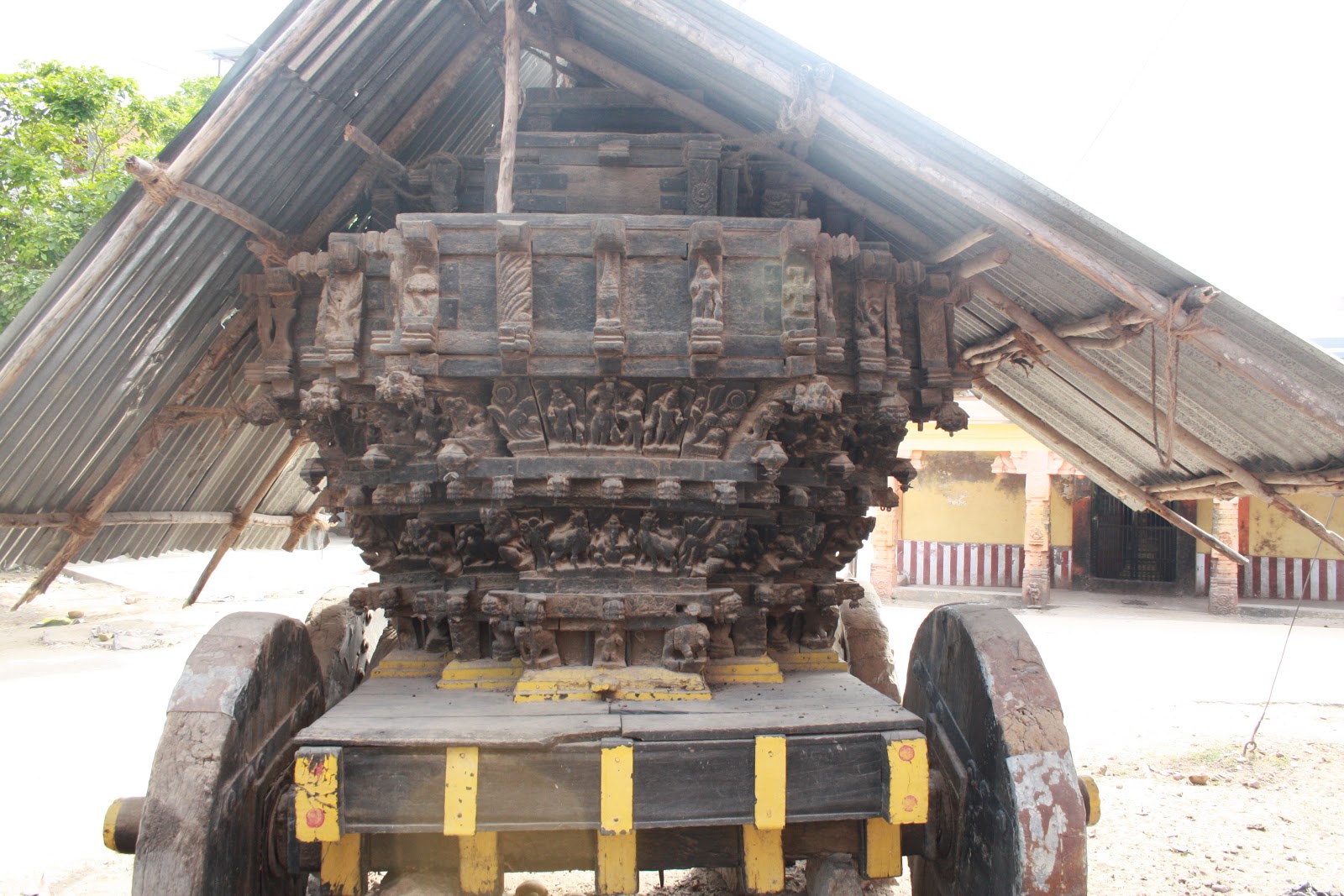
On the roof
of the pagoda, which is covered with large plates of highly polished silver
placed in a regular fashion one against another, there are eight balls slightly
elongated a little bit like pine cones made of gold filigree forming a crown, a
great accomplishment which, when the sun shines above is of such brilliance to
prohibit the use of sight. As for the underside of the roof, in the interior,
it is decorated with silver and gilded carved wood.
The Brahmins
believe their god created the world, that he was born poor, lived in such a way
and performed miracles. He is represented as a beautiful young man, having four
hands which he uses to distribute blessings and ache, and, under the arms, four
deities subalterns which he commands to do good or evil { 81 }, depending more
or less the zeal of the believers. Our guide provided us all these explanations
with a fervour of faith and devotion which, far from touching us, made us want
to laugh.
By a
special permission made to the French nation by the Governor of the pagodas,
we were allowed to approach into the nearness of the divinity without leaving
our shoes. It is customary to present the Governor with a gift proportionate to
the nature and quality of the visitors; ours was four ells of scarlet and a
mirror of twenty crowns, and this present was so well liked that we had free
access throughout the pagoda .
When we
went out to go to dinner in a beautiful garden which adjoins, our visit had
lasted four good hours. We had brought, as I had said, all that necessary for
our dinner, and the governor had sent us tables, and even although they are not
in use with the peoples of the East, chairs which he had made especially for European
visitors. He also sent us the dancing girls and musicians assigned to the
pagoda and had brought to us all kinds of fruits, herbs and dairy, not to
mention the betel which, in India,
is a sign of hospitality and consideration.
After we
had dined at some length, the sound of discordant music but under the
enchanting charm of bayadères dancing, we returned to the pagoda, escorted by
about two thousand armed men, which { 82 } came by order of the Governor in
front of our palanquins and in such a way honoured us.
It was
still the same Brahmin who accompanied us and directed us to the places where we had not yet been. He showed us
immense storerooms built of stones with surprising width and length, in which
they stored the grains harvested in the land belonging to the pagoda and others
with the offerings of the faithful, who, some days of the year are brought and
deposited at the foot of the idol by those who had requested his grace and
favour. These offerings are made of various things, such as cotton, silk, rice,
crowns, cows, milk, etc. . Although prodigiously large, these beautiful stores are
filled every year. At the same time they are emptied for the support of those
committed to protecting en maintaining the pagoda and to help the needy, when
the country is in a shortage of rice or other grains, as often happens in this
remote region of Pondicherry.
We
continued to follow our guide who showed us around, still within the precincts
of the pagoda, other large buildings, also built of huge stones, which housed
in separate chambers and more or less daily, fifteen hundred Brahmins attached to
the pagoda as well as musicians and dancing girls who are connected. In the
same building are also the housing of the guards, which is composed of three
thousand men, armed with rifles or arms and arrows. { 83 }
At the
beginning of the night, when we left the pagoda, we had visited in the smallest
details, and after admiring the last time the main gate, we returned to Porto-Novo to go from there back to Pondicherry, about which I have a few more
words to say.


.JPG)