Showing posts with label temple. Show all posts

Sunday, October 21, 2012

Cosmic Meru and the Temple Chariot


The great temple chariots of South India are amazing structures for amazing events, architecturally and artistically. They are at the centre of the grand festival or utsava celebrated once a year. Each temple has its own tradition with respect to the calendar and also the number of days and the progression of the processions. But the chariot day is always the central feature and also the most spiritually and aesthetically inspiring.

Temple chariots in Chidambaram

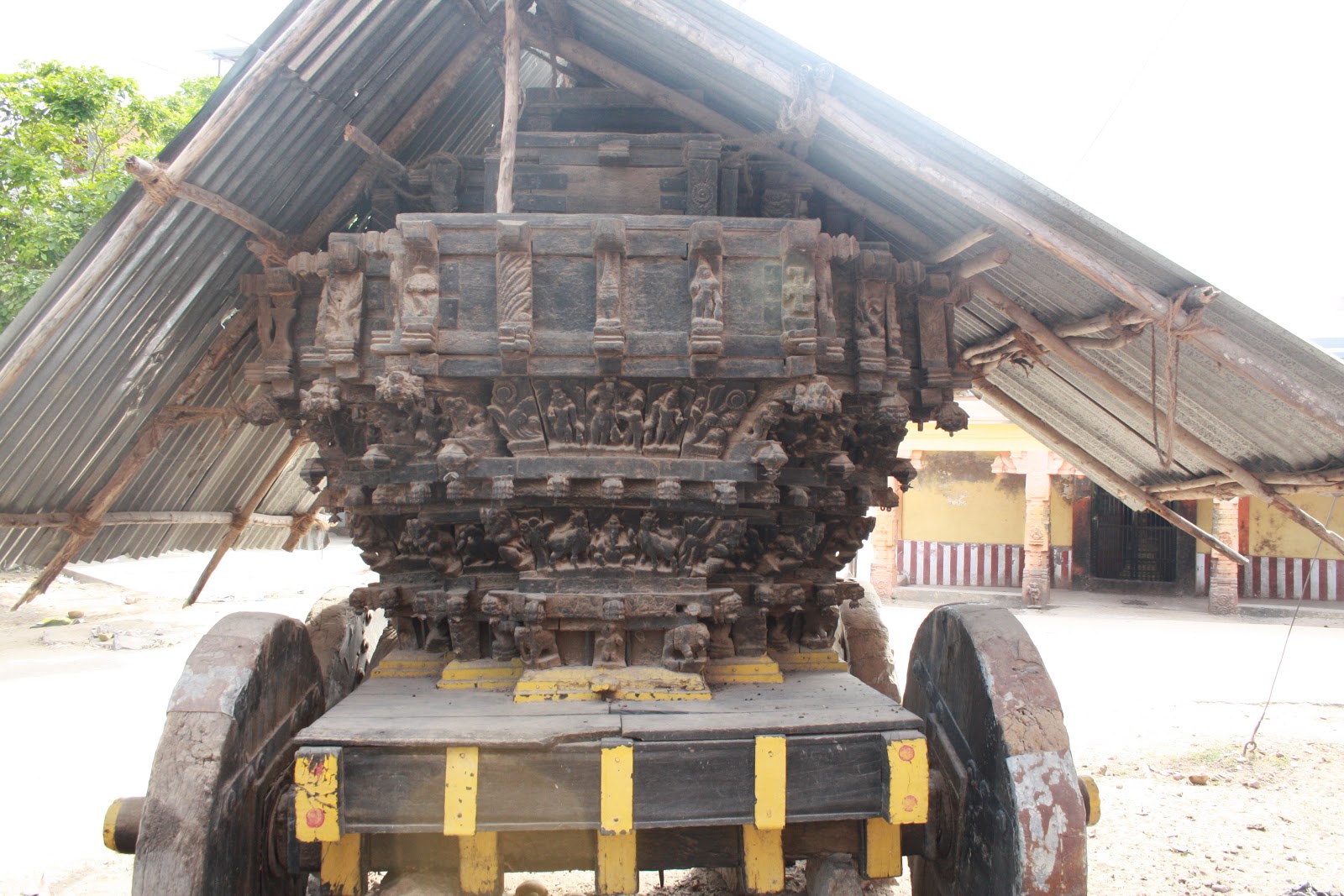
At the same time the ratha or ter, as the chariot is called in Sanskrit and Tamil, is quite mysterious. Structurally it is an upside-down pyramid on four wheels made of wood. On top of this pyramid is a small dais which is also a stepped pyramid, but right side up. For the occasion of the actual festival a temporary upper structure will be constructed of poles which will be covered by colourful cloth. Although every temple has its own specific details, generally these upper structures also have a pyramidal structure and shape.

Some time ago a much respected FB friend, VJ Kumar, who is a fellow enthusiast, raised the question why the chariots are sometimes so huge, while the murtis which ride in them for the processional ride around the car streets are not very large at all. This is a very good question. The general question of the relationship between the form, function and meaning of the South Indian temple chariots has so far hardly been asked. Searching the literature we have to draw the conclusion this question has not enjoyed any attention so far. So I thank my FB friend for bringing it up. From my late friend Raja Deekshithar I understood the essence of this a long time ago. But the time, and also the material or textual proof was not ready. During one of our recent trips we accidently came across one crucial proof.

The relief from Madurai which was posted by Ramjee Nagarajan depicts another interpretation of the same idea. Here the Cosmic Turtle carries the Nagas and the Elephants on whose backs Shiva and Parvati are depicted as Somaskanda or as Uma-Maheshvara. (I am not sure Skanda is present here in between his father and mother, a more detailed photo could clarify this).

With thanks to Ramjee Nagarajan
The ritual ratha, ter or chariot is first and foremost a physical representation of Meru, and Meru is the Cosmic Mountain and World Axis. What is the proof for this? Two reliefs depicting Meru in a simplified form establish the connection. The first Kandhan and I found in an eclipse pavilion on a short trip to Tiruvannamalai. This alone standing mandapa somewhere along the road has the usual eclipse depictions of nagas with lunar and solar disk, makara, fish and other eclipse symbols (http://www.asianart.com/articles/pavilion/index.html;  http://www.asianart.com/articles/pavilion2/index.html ) besides cosmological symbols. One is a small relief of Meru with the Shiva Linga on the summit.

Here Meru is carried on the back of the World Turtle. On the back of the turtle Nagas or cobras carry the next level, that of the Cosmic Elephants. On the back of the elephants rests the actual mountain, on top of which is a platform in the shape of an inverted lotus. The whole is crowned with the Formless-Form of Shiva, the Linga.

Meru the Cosmic Mountain

That this is a depiction of ancient cosmological concepts can be understood from some of the ritual platforms we find in festival mandapas, for instance in Madurai itself. In the Thousand Pillar Hall the large stone Nataraja and Sivakamasundari are placed on a ritual platform shaped in the form of the Cosmic Turtle. The Cosmic Turtle carries on its back the Cosmic Nagas and Elephants, and the Dikpalas, the Lords of the Directions are positioned at their appropriate places. Atogether this forms the platform which is the stage of Shiva’s Cosmic Dance.

The Cosmic Turtle offering his back as the stage of Shiva's Cosmic Dance in Madurai
Another such platform is found in an eclipse pavilion in the outer prakara of the lower temple in Thirukallukundram. Alas Time has robbed this Cosmic Turtle of its head. Nagas, Elephants, the Lords of the Directions, and miniature mountain peaks complete the symbolism of the Cosmic Meru. It was obviously a platform for the performance of ritual. Possibly in connection with eclipses, as an eclipse is depicted in the ceiling above the ritual stage.

Here the Cosmic Turtle carries Mount Meru in Thirukallukundram
 Now what is the connection between these depictions of Meru and the festival chariot? The chariot actually represents the same concept. Not on all chariots we find all the symbolism combined in the same way, but many do, and they make the connection clear. Here I present two chariots. Both are from Chidambaram. The first is the large chariot for Ganesha which belongs to the great festival of the Shiva Nataraja temple. The other a small chariot belonging to a Vinayaka temple some distance away from the great temple in the centre of the city.

 We again find the Cosmic Turtle carrying the whole universe on its back. Here the turtle is also depicted in human form, it seems. On its back nagas and elephants, and above these the whole cosmos of worlds with heavenly beings and deities. I don’t have a photo of this, but the tail and the feet of the turtle stick out at the back and the sides of the chariot.


The second chariot also has the human form of the Cosmic Turtle represented. On its back once again the Nagas, the Elephants and miniature mountain peaks. This small chariot clearly shows the inverted pyramid structure and the layers of divine worlds.


We can conclude the ratha or ter of South Indian temple festivals is a representation of the Cosmic Meru, which is at the same time the world axis, the skambha. Both the Turtle and Meru itself are other forms of the divine. The size doesn’t seem to be as significant. Possibly bigger chariots were build for the larger temples, in the same way the gopura seems to have become higher over time.

I hope this clarification of the meaning and function of the ritual festival chariot will help us all to understand the significance of the ancient traditions better. And the next time I pull the chariot with the Nataraja in it I will realise all the more He is the embodiment of the whole cosmos. And the festival is its unfolding.

© 2012 Liesbeth Pankaja Bennink

Monday, May 21, 2012

Shiva, Universal Guru, Dakshinamurti


Shiva as Dakshinamurti represents the Guru, the teacher, He who initiates and gives knowledge to those who seek it. He is the personification of supreme knowledge and wisdom. And he is worshipped as the god of divine wisdom.

Shiva as Dakshinamurthy
Dakshina first means the right direction. For almost all auspicious acts and rituals we face East, because the East is where the sun rises every day. It is where auspiciousness is born. When we face East, our right hand side is the South. That is how the Southern direction came to be know as 'dakshina'. And Shiva in his aspect of divine teacher is always facing South and is therefore called Dakshinamurti. When we enter a temple in southern India and follow the prakara in the clock-wise direction, we find Dakshinamurti in the central niche of the southern wall of the sanctum.

Around him sit four sages who are named Sanatkumara (always a youth), Sanaka (ancient), Sanatana (eternal), Sanandana (having joy). They are born from the mind of Brahma and live eternally as Brahmacaris. With the chin mudra Dakshinamurti and with great silence he teaches his four sishyas or disciples the meaning of Brahma Vidya, the knowledge of Brahman. The significance of Brahma Vidya is to realise Parabrahmam or the divine knowledge or wisdom. To know about the Brahmam is to know about the Paramatma. Through this teaching they receive all kinds of knowledge and wisdom.

Dakshinamurthy sits in a yogic pose called veerasana. He sits on a tiger skin which shows his yogic powers. With one leg he connects to our world, the world of ignorance and illusion. His other leg is folded across in a yogic pose, generating the energy. In his hair he wears the crescent moon. On his forehead is his third eye. In his four hands he holds his attributes. The tradition reaches us about 108 forms of Dakshinamurti. Among these Jñana Dakshinamurthy, Samhara Dakshinamurthy, Lakudi Dakshinamurthy, Yoga Dakshinamurthy, Metha Dakshinamurthy, Samba Dakshinamurthy and Veenadhara Dakshinamurthy are the most familiar.

He sits under the asvattha tree. This is the sacred tree which is described in the Veda as having its roots in heaven and its branches below in our world. It is the tree which represents the cosmos. Of tis it is said in the Katha Upanishad

This is That eternal Asvattha Tree with its root above and branches below. That root, indeed, is called the Bright. That is Brahman, and That alone is the Immortal. In That all worlds are contained, and none can pass beyond. This verily is That.”
(Katha Upanishad II.iii.1)


When we worship this great lord who offers us darshan under that Cosmic Tree we will receive great knowledge and wisdom.

Kandhan Raja


Thursday, February 18, 2010

Mysterious Pavilion part 2; the wonder continues

.2.

After my discovery of the astronomical reliefs in a pavilion near Mahabalipuram (for more photos and information please read my article published on “Asian Art” (www.asianart.com/articles) I have been searching and researching this mysterious and little known astronomical symbols in Indian art. Below are photos from several different temples and pavilions from across South India showing further depictions of eclipse symbolism. Nagas or cobras chasing the sun and moon, many different fish, some normal, some strange, tigers, lizards, parrots or phoenixes, makaras, tortoises and much more. I am continuing my research and hope to publish more details soon.

These are photos of eclipse related astronomical symbols depicted in relief on ceilings, walls, and preserved slabs from pavilions no longer in existence from a temple. Especially significant are the naga dragons with the sun and moon, which are flanked by phoenix-like birds. Other ceilings in the same temple show a connection between these ferocious animals and eclipses. The ceiling of a Ganesha shrine within the complex depicts a lunar and solar eclipse flanking a simple circle-in-square mandala. Above the entrance a relief depicts the sphinx or purushamriga worshipping the Shiva Linga, while in pursuit of Bhima, one of the Pancha Pandavas (www.sphinxofindia.rajadeekshithar.com). On the walls and the ceiling of the gopuram again depictions of nagas, fish, a moray eel, tigers, a monkey, the sun and the moon.

The small isolated pavilion has many eclipse related symbols depicted on its ceiling.

Another pavilion by the side of a road next to a shrine of Ganesha has been fenced off by the ASI for its protection. But fish and other relief figures were visible from the distance. On its front a peculiar symbol, resembling in a more abstract way the birds by the side of the sun and moon depicted on the slab in the other temple (see above). And the grinning face with fangs and a pair of hands similar to such faces on the pavilion near Mahabalipuram.

The ceiling of the Ganesha shrine next to it also depicts nagas, lunar and solar eclipses, and pairs of fish. In this case the ceiling has been painting freshly to show clearly the gobes in front of the cobras or nagas are intended to represent solar and lunar eclipses. One pair of fish has also been painted; another is faintly visible under the whitewash. The pillars of this small shrine also had lunar and solar disks carved on them. This shows these reliefs are understood today as reflecting significant astronomical events in the living tradition. They are conscious documents of astronomical events and also understood as such in the living tradition.

Some of the photos below show the ceiling of a veranda or porch in a large and very ancient temple. Again we see strange fish and makaras.

More nagas and fish accompany lunar and solar disks on a ceiling of a small temple. The temple belongs to the Pallava dynasty, but the pavilion in front probably to the 17th century.